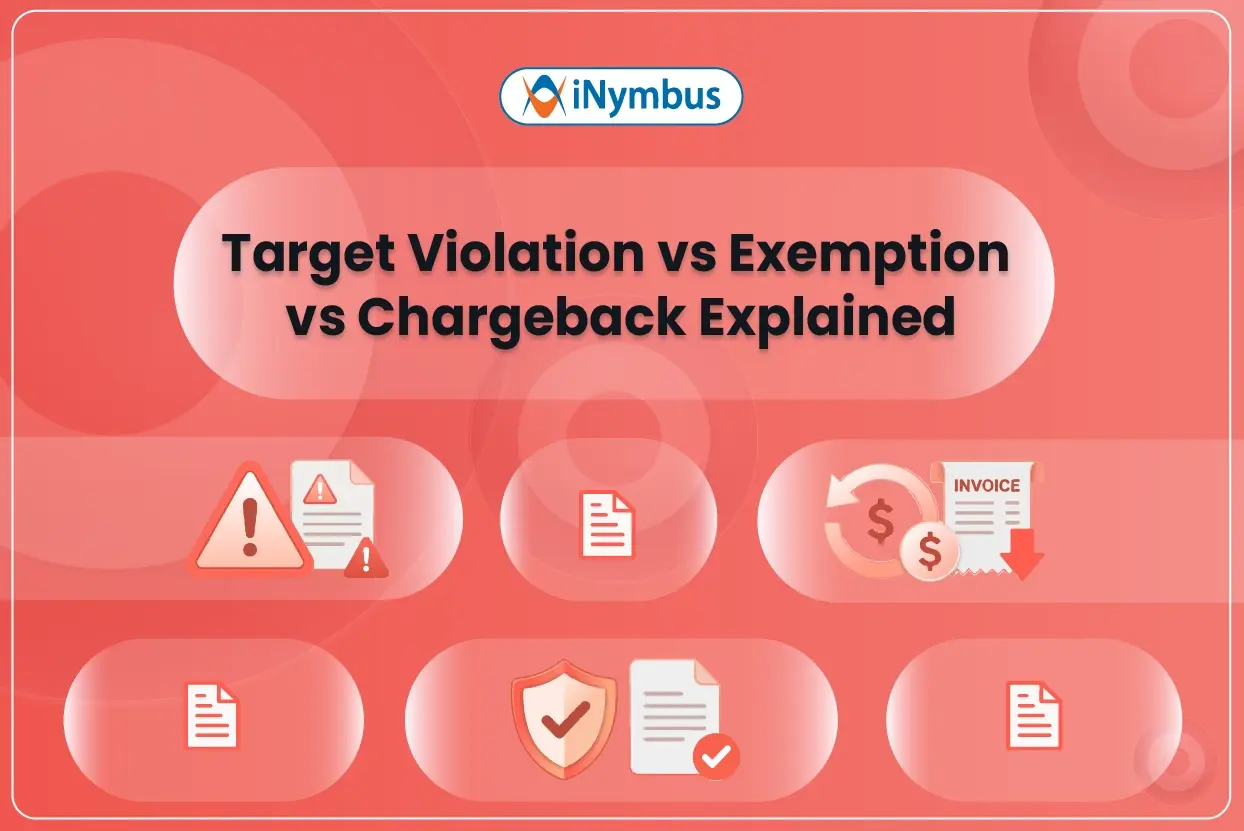

Quick answer: At Target, a violation is a compliance miss that stays open for two weeks. In that window, you can request an exemption, or Target may grant an exception on its own. If neither happens, the violation becomes a chargeback. If the chargeback is invalid, you dispute it in Synergy and, if approved, receive a reversal.
These are Target supplier compliance terms, not payment card chargebacks. If you sell to Target and see a line on your remittance that you do not recognize, this guide helps you identify which stage it is in and what to do next. For the full list of codes behind those remittance lines, see our guide to Target Deduction Codes Explained: A Complete Overview.
What do the five Target compliance terms mean?
Target uses five terms that are easy to confuse because they describe different stages of the same process. Here is each one explained.
|
Term |
Meaning |
Who starts it |
When |
Your move |
|
Violation |
A system-generated compliance assessment |
Target's system |
Active for 2 weeks from creation date |
Review it in the SPMD dashboard |
|
Exception |
Target removes an invalid violation on its own |
Target's SPM team |
During the violation window |
Nothing, but confirm it cleared |
|
Exemption |
You ask Target to remove the violation before it becomes a deduction |
You, the supplier |
Within the 2-week window, one ticket per scenario |
File in Partners Online with proof |
|
Chargeback |
The deduction taken when a violation ages out |
Target's system |
After day 14 with no exemption or exception |
Dispute in Synergy if invalid |
|
Reversal |
Money returned after a successful dispute |
Target's SPM team |
After your Synergy dispute is approved |
Match the credit to the original chargeback |
How does a Target violation become a chargeback?
The five terms are really one timeline. Here it is in order:
- Day 0: Target's system creates a violation. It appears in the Supplier Performance Management Dashboard (SPMD).
- Day 1 to 14: The violation is open. Target may grant an exception, or you can file an exemption request.
- Day 15: If nothing removes it, the violation becomes a chargeback and is deducted from your payment.
- After the chargeback: You dispute invalid chargebacks in Synergy with your proof documents.
- Resolution: If Target agrees, the SPM team issues a reversal.
What does this look like for one late shipment?
Say a PO worth $20,000 in cost of goods arrives at a Target DC two days late. Here is how it plays out when your team acts in time:
- Day 0: An On Time violation posts. At 3% of COGS, that is a $600 assessment.
- Day 3: Your team checks SPMD and sees the violation. Your carrier's records show Target moved the appointment.
- Day 5: You file one exemption ticket in Partners Online with the appointment history attached.
- Day 12: The SPM team approves it. The $600 never leaves your payment.
Now, the same case if nobody checks SPMD:
- Day 15: The violation becomes a $600 chargeback.
- Week 4: Your AR team spots it on the remittance and files a Synergy dispute with the same proof.
- Week 10: Target approves a reversal. You get the money back, but it took two months and a lot more work.
The lesson is simple. Exemptions are cheaper than disputes. The fastest money is the money that is never deducted.
What is the difference between an exception and an exemption?
Both remove a violation before it turns into a chargeback. The difference is who acts.
- Exception: Target's SPM team removes it on its own. A common example is a natural disaster that blocks deliveries to a DC.
- Exemption: You ask for it. You must file within the two-week window, and you need one ticket per scenario.
You cannot plan on exceptions. You can plan on exemptions.
What would have made it an exception instead?
Exceptions happen when the cause is clearly on Target's side or outside anyone's control. Examples include a DC closure, a weather event, or a Target system outage. If you think a violation fits, still file an exemption. Do not wait for Target to notice.
Is a Target violation the same as a deduction?
No. A violation is a warning with a clock on it. A deduction is money already taken from your payment.
It also helps to separate two kinds of Target deductions:
- Compliance chargebacks come from violations such as late delivery, fill rate, or ASN errors. These are the Vendor Performance deductions (On Time Ship, Fill Rate/SIFR, and EDI 856 Availability), and they follow the lifecycle above.
- AP deductions such as an A030 carton shortage come from receiving and invoice gaps. They follow a different dispute path and window. Learn how to read them in our Target deduction prefixes guide and the complete Target deduction codes list.
How long do you have to dispute a Target chargeback?
Our reading of Target's compliance guidance is 3 months from the date the violation becomes a chargeback. The Compliance Research Report shows a Dispute Expiration Date for each one, so use that date as your source of truth. Late disputes are denied without review.
AP deductions follow longer windows. For prepaid shipments, it is 18 months from the document date, and 9 months for collect shipments. Our Target dispute deadlines guide covers every window in one place.
Where do you file a Target exemption request?
In Partners Online, through Request Support under the chargeback exemption path. Attach the Violation Summary Report and your proof. If the violation has already become a chargeback, open a dispute case in Synergy instead. Our walkthrough on how to dispute Target deductions covers the steps.
Which related Target terms should you know?
- SPM: Supplier Performance Management, the team that rules on exemptions and reversals.
- SPMD: the dashboard where violations appear. Learn it with our SPM dashboard guide.
- Synergy: Target's portal for disputing chargebacks and deductions.
- OTFR: On Time and Fill Rate, Target's version of OTIF. See how to fix Target OTFR chargebacks.
- Compliance violation: see our glossary entry.
How iNymbus Helps with Target Violations and Chargebacks
Most suppliers miss exemptions because nobody checks SPMD every week. iNymbus uses Robotic Process Automation (RPA) to catch violations and chargebacks early and file the right claim on time.
- 30x Faster Dispute Processing: From writing descriptions to fetching required documents and uploading them to the retailer portal, iNymbus automates claim filing.
- 50+ Retailer Support: iNymbus has built-in knowledge of retailer-specific deduction and dispute processes, including Target's.
- Advanced Data Analysis: Spot trends and root causes behind recurring violations so you can prevent them, not just dispute them.
Grab the free Target Deduction Booklet or book a call to see iNymbus work on your own data.
Frequently Asked Questions
Still Chasing Deductions Manually?
Recover lost revenue with iNymbus automation