
Walmart vendor compliance is the set of packaging, routing, data, and delivery rules every supplier must meet, and Walmart enforces each one by deducting automatically when a shipment falls short. A single late, short shipment can trigger charges from four programs at once, each disputed in a different system with a different deadline.
This guide organizes the rules the way a shipment moves: from PO confirmation to packaging, routing, pickup, delivery, and payment. Each section shows where the rule is measured, what a miss costs, and how to dispute charges that should not have posted.
What Is Walmart Vendor Compliance?
Walmart vendor compliance is the set of supply chain, packaging, transportation, and data requirements suppliers must meet when shipping to Walmart and Sam’s Club facilities. Walmart measures compliance automatically at receiving and through transportation data, and recovers failures through fines, claims, and deductions on supplier payments.
The requirements come from four sources:
- Supply Chain Packaging Guide: case quality, ISTA testing, pallet standards, labeling, and barcodes
- Shipping and Routing Guide: PO confirmation, routing, scheduling, loading, BOLs, and accessorial charges
- EDI mapping guides: ASN (EDI 856), invoice (EDI 810), and acknowledgment requirements
- Supplier agreement: payment terms, allowances, and freight terms
Shipments that don’t follow routing guidelines can also result in post-audit claims after payment.
Walmart Compliance Programs at a Glance
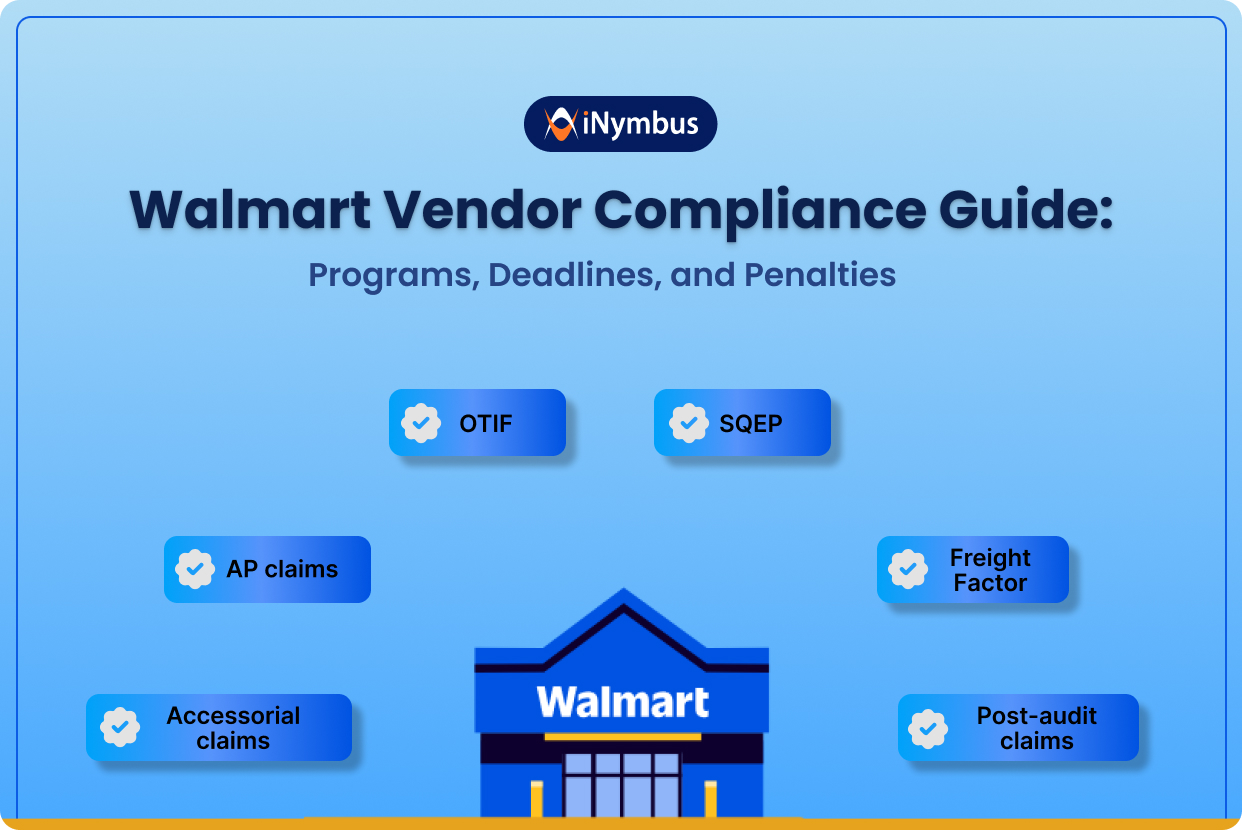
Walmart enforces compliance through six programs that can overlap on the same shipment. Each has its own measurement, penalty, and dispute path.
|
Program |
What It Measures |
Penalty |
Where to Monitor |
Where to Dispute |
|
OTIF |
On-time and in-full delivery at the case level |
3% of cost of goods on non-compliant cases |
OTIF scorecard in Retail Link, Performance in Supplier One |
APDP, about 30 days |
|
SQEP |
Right Item, Right Invoice, Right Condition, Right Time |
$200 per PO plus $1 per non-compliant case |
SQEP Dashboard |
EIPP, 13 months, exact-penny match |
|
AP claims |
Invoice vs. PO vs. receipt mismatches |
Value of the shortage or price difference |
Payments in Supplier One, APIS |
APDP |
|
Accessorial claims |
Transportation failures such as detention and TONU |
Carrier charge, plus a processing fee for detention |
Remittance detail |
Team Support Portal and AP disputes |
|
Post-audit claims |
Routing guide and agreement violations found after payment |
Varies by finding |
Remittance detail |
Auditor contact on the claim |
|
Freight Factor |
Shipping cost as a share of product cost (Collect) |
Higher unit cost, not a fine |
Freight Factor reports |
Not disputable |
OTIF measures whether the delivery worked. SQEP measures whether the freight and its data were correct on arrival. For a full comparison, see Walmart OTIF vs. SQEP.
The Walmart Compliance Timeline: Every Deadline From PO to Payment
Most Walmart compliance failures are timing failures. These deadlines apply to a Collect shipment, in the order they occur:
|
Stage |
Deadline |
What Happens If You Miss It |
|
PO received |
Confirm in TSCP 2.0 by 4:00 p.m. Central the next calendar day |
Late routing, OTIF risk |
|
Manual PO |
Confirm up to 30 days before MABD; if received within 30 days, by 4:00 p.m. Central next day |
Late routing, OTIF risk |
|
Before confirming |
Product must be physically available by the DNSB |
Missed pickup, reconfirmation, cube inflation claims |
|
Carrier accepts tender |
Carrier contacts you within 24 hours; you respond within 12 hours |
Supplier service failure, OTIF fines |
|
No appointment set |
Contact the carrier if none is set within 24 hours of the CPD |
Missed CPD |
|
Preloaded drop trailer |
Load no more than 48 hours before the CPD; hand over within 30 minutes of carrier arrival |
TONU |
|
Driver arrives on time |
Loading complete within 2 hours of the appointment |
Detention charges or TONU |
|
Shipment departs |
ASN accepted before the trailer gates in at the DC |
SQEP Right Invoice defect |
|
Invoicing |
Do not bill before the MABD |
"Billed not shipped" claims |
|
Deduction posts |
APDP disputes within about 30 days; SQEP disputes in EIPP within 13 months |
Permanent write-off |
Two timing rules suppliers miss
- Reconfirming resets the clock: Walmart measures on-time routing from the most recent routing of the PO, so reconfirming a PO restarts the measurement
- Collect POs aren’t measured on MABD delivery: the Carrier Pickup Date Walmart assigns may not align with the MABD, so Collect suppliers are measured on routing correctly and being ready at pickup
Walmart Packaging and Labeling Requirements
Packaging and labeling failures fall under SQEP’s Right Condition and Right Invoice categories, and Right Condition is the largest source of SQEP fines.
ISTA Transit Testing
Walmart requires items to pass ISTA transit testing before they ship into its network. The protocol depends on how the item moves:
- ISTA 6A (FedEx): parcel and eCommerce flow
- ISTA 3A: small parcel items
- ISTA 3B: LTL freight
Testing is required for items shipped as 1/1 units and for cases where any side exceeds 25 inches, the second largest side exceeds 20 inches, or the case weighs more than 30 pounds. Walmart may request a retest for items with damage rates above the department average.
For departments using email test collection, Walmart specifies the subject line format for submitting results. Getting it wrong delays your record:
BU_DEPARTMENT_BRAND TYPE_SUPPLIER NAME_IMPORT OR DOMESTIC_ISTA TEST TYPE_DATE
Example: HOME_D17_PB_COMPANY NAME_IMPORT_ISTA6A_092722
Pallet Standards
|
Requirement |
Standard |
|
Size |
48" x 40" footprint, no overhang |
|
Quality |
Grade A, minimum 7 top boards |
|
Weight |
Grade A pallets up to 2,100 lbs loaded; block pallets up to 2,800 lbs |
|
Height |
96" maximum including the pallet |
|
Full pallet pull |
85" maximum |
|
Exception |
Department 4 consumer paper goods up to 108" |
Pallets that fail these standards can trigger fees or chargebacks. For LTL, carriers can also charge sort and segregation fees back to the supplier when freight is not palletized.
Labels and Barcodes
Cases and pallets need GS1-128 labels with SSCC-18 codes that match the ASN. Print-and-apply barcodes must meet ANSI print quality requirements, and labels cannot be folded over the edge of the case. A barcode that fails to scan stops automated receiving and generates both a labeling defect and downstream rework. For ASN setup and SSCC rules, see our Walmart ASN guide.
Walmart Routing and Transportation Compliance for Collect Suppliers
Collect suppliers ship on Walmart-arranged carriers, so routing accuracy drives both OTIF performance and freight cost.
Confirming POs in TSCP 2.0
Confirming a PO in the Transportation Supply Chain Portal (TSCP 2.0) tells Walmart the freight is ready to ship, so route only product you physically have available. Before confirming, check that the case count, weight, and cube or pallet count match the freight exactly. After a load is created, do not reconfirm the same POs for a new load; doing so creates duplicate routing and delays pickup.
Cube Inflation
Cube inflation is requesting more trailer space than the freight needs. Walmart charges the supplier for the extra freight cost, and inflation also raises your Freight Factor, which increases unit cost.
Short-shipping a PO and then reconfirming it also counts as cube inflation and generates post-audit claims. Compare the cube in Routing Status with the PO’s cube in NOVA to catch it early.
Cancelled POs and MABD Changes
NOVA, where Replenishment manages POs, and TSCP 2.0, where Transportation routes them, do not share updates. When a PO is cancelled in NOVA, open a Team Support Portal ticket to cancel the routing. If a cancelled PO ships anyway, the shipping cost is charged back to the supplier.
MABD changes follow the same process: cancel the routing through a ticket, get the new dates from your Replenishment Manager, then reconfirm.
Overflow
When freight doesn’t fit on the assigned trailer, fill the trailer completely, even if that means splitting a PO. Then:
- Photograph the empty trailer on arrival
- Load as much freight as fits
- Photograph the full trailer and the freight left on the dock
- Open a Team Support Portal ticket (Freight Doesn’t Fit/Incompatible, reason: Overflow) with the photos and specs of the remaining freight
Walmart can charge additional freight costs for the remaining POs to the supplier, so the photos are your evidence.
LTL and Small Parcel (SSPI)
POs smaller than a standard pallet position that qualify for small parcel shipping must be confirmed as FLOOR. SSPI freight cannot be palletized or master-packed. The supplier pays pickup fees and fuel surcharges and must not declare value or buy insurance on packages shipped to Walmart.
Small parcel claims and disputes require one tracking number and POD for each case invoiced. A single POD covering several cases does not qualify.
Walmart Pickup, Loading, and BOL Requirements
Pickup and loading failures create detention, TONU, and OTIF charges, and a non-compliant BOL weakens every dispute that follows.
Pickup Appointments
Schedule pickups only with the carrier assigned in Routing Status, and reference the Walmart Load ID. Confirm appointments by email or scheduling system so there is a record if Walmart needs it.
Pushing a pickup past the assigned Carrier Pickup Date does not fix a readiness problem. If the late pickup causes a late delivery, the load is coded against the shipper and counts against your OTIF score. The exception: when a carrier moves the date because the DC has no delivery appointments, the load is coded against the DC.
Collect suppliers may not charge fees to carriers.
Loading Rules
- Two-hour loading window: drivers who arrive on time must be loaded within 2 hours, or detention starts accruing
- Legal weight: overweight loads return for rework, which can add out-of-route miles and stop charges
- California bridge laws: loads entering California must meet its stricter axle rules, even if they left origin legally
- Seals: seal the trailer with your own seal and record the number on every copy of the BOL
- PO separation: multiple POs on one truck must each be loaded separately and kept together
Bill of Lading Requirements
Every Collect BOL needs:
- Walmart load number
- All PO numbers on the shipment
- Number of shipping units (pallets for palletized freight, cases for floor-loaded freight)
- Carrier name, SCAC code, and trailer seal number
- Freight terms marked Collect
- Correct consignee name and address
Handwritten corrections are not allowed. POs going to the same DC address must ship on one BOL, and LTL POs from the same ship point to the same DC on the same day must also share a BOL.
For Collect shipments, the carrier-signed BOL is your proof of delivery for payment disputes. Walmart does not provide suppliers a copy of a clear POD.
Walmart Accessorial Charges Deducted Automatically
Walmart deducts transportation charges from the supplier’s account automatically when the supplier causes them.
|
Charge |
Trigger |
How to Prevent It |
|
Detention |
Driver not loaded within 2 hours of an on-time arrival; includes a processing fee |
Stage freight before the appointment |
|
Truck Order Not Used (TONU) |
Truck requested but not loaded |
Notify the carrier in advance if freight will not be ready |
|
Out-of-route miles |
Extra miles driven, including mis-shipped POs |
Confirm POs for the correct ship point; call Inbound Transportation before recalling a truck |
|
Portion of truck not used |
Space miscalculated or freight loaded so the trailer cannot be filled |
Confirm accurate cube and pallet counts |
|
Rework |
Load shifted in transit due to poor loading or bracing |
Block, brace, and stack to standard |
|
Stop-off |
Carrier has to make an extra stop |
Confirm each PO for the right ship point |
How One Walmart Shipment Triggers Six Compliance Charges
One readiness problem can produce six charges across four programs, each disputed in a different place. This example uses illustrative numbers.
The shipment: a Collect PO for 1,000 cases at $20 per case ($20,000 total). The supplier confirms the PO before all product is ready. On pickup day, 60 cases are still missing and the freight isn’t staged. The driver waits 3 hours. The ASN is accepted after the trailer gates in at the DC.
|
What Went Wrong |
Program |
Estimated Exposure |
|
60 cases invoiced but not received |
AP shortage claim |
60 x $20 = $1,200 |
|
Freight not ready at pickup |
OTIF On-Time (Collect Ready) |
3% x $18,800 shipped = $564 |
|
60 cases short |
OTIF In-Full |
3% x $1,200 = $36 |
|
ASN accepted after gate-in |
SQEP Right Invoice |
$200 per PO plus $1 per non-compliant case |
|
Driver waited past 2 hours |
Accessorial detention |
Carrier detention charge plus processing fee |
|
Supplier reconfirms the short PO |
Post-audit cube inflation |
Extra freight cost |
Some of these charges are valid; others may not be. If the DC’s receiving count was wrong, the shortage and In-Full charges are disputable with a carrier-signed BOL. If the ASN was transmitted before gate-in but recorded late, the SQEP charge is disputable with 856 and 997 timestamps in the DC’s local time zone.
The pattern holds across every Walmart compliance program: winning a dispute depends on records captured on shipment day, not after the deduction arrives.
Who Owns Each Walmart Compliance Area
Walmart compliance failures surface in AR but originate in other departments, so assigning an owner to each area is the fastest way to stop recurring charges.
|
Compliance Area |
Owner |
How Failures Show Up |
|
ISTA testing, case and pallet quality |
Packaging and operations |
SQEP Right Condition fines |
|
Labels and barcodes |
Warehouse operations |
SQEP labeling defects, rework |
|
PO confirmation and routing |
Transportation or logistics |
OTIF Collect Ready failures, inflation claims |
|
Appointment scheduling and loading |
Shipping and dock teams |
Detention, TONU, OTIF failures |
|
ASN and EDI |
IT and EDI team |
SQEP Right Invoice defects, shortage claims |
|
Item setup, cost, and pack data |
Merchandising and sales |
Code 10 price claims, case pack shortages |
|
Invoice timing and disputes |
Accounts receivable |
Billed not shipped claims, missed windows |
Where to Monitor Walmart Compliance
Review OTIF, SQEP, and ASN dashboards weekly; a monthly review leaves too little of the 30-day APDP window to act.
- Retail Link OTIF Dashboard: on-time and in-full performance by PO and case
- SQEP Dashboard: defects by Right category, with the exports required for EIPP disputes
- Advance Ship Notice Dashboard: missing, late, and mismatched ASNs
- TSCP 2.0 Routing Status: load numbers, carrier assignments, and CPDs
- Supplier One: payments, deductions, OTIF trends and charges, and scorecards
- Team Support Portal: tickets for routing cancellations, overflow, and missed pickups
How to Dispute Walmart Compliance Charges
Each Walmart compliance charge has its own dispute path, deadline, and evidence requirement:
|
Charge Type |
Where to Dispute |
Deadline |
Evidence |
|
OTIF and AP claims |
APDP in Retail Link, at the line level |
About 30 days |
POD, BOL, carrier appointment records, TSCP 2.0 routing records |
|
SQEP fines |
EIPP, one invoice per dispute, at the item level |
13 months; amount must match backup to the cent |
SQEP Dashboard exports, 856 and 997 timestamps, photos |
|
Routing and transportation issues |
Team Support Portal tickets |
As soon as the issue occurs |
Photos, carrier correspondence, SCAC codes |
Strong disputes depend on records captured at the time of shipment: signed BOLs, trailer photos, appointment confirmations, and EDI timestamps. For the payment side of the process, see our guide to the Walmart invoicing and payment lifecycle.
Recover Walmart Compliance Charges With iNymbus
Walmart compliance charges arrive through several systems at once: OTIF in APDP, SQEP in EIPP, accessorial and post-audit claims on remittances. Matching each charge to the right BOL, POD, ASN timestamp, and routing record inside its window is where most AR teams fall behind.
iNymbus automates that work. It pulls Walmart deductions and compliance data, matches each charge to your shipping and EDI records, and files disputes through APDP or EIPP before the deadline, including SQEP disputes reconciled to the exact cent.